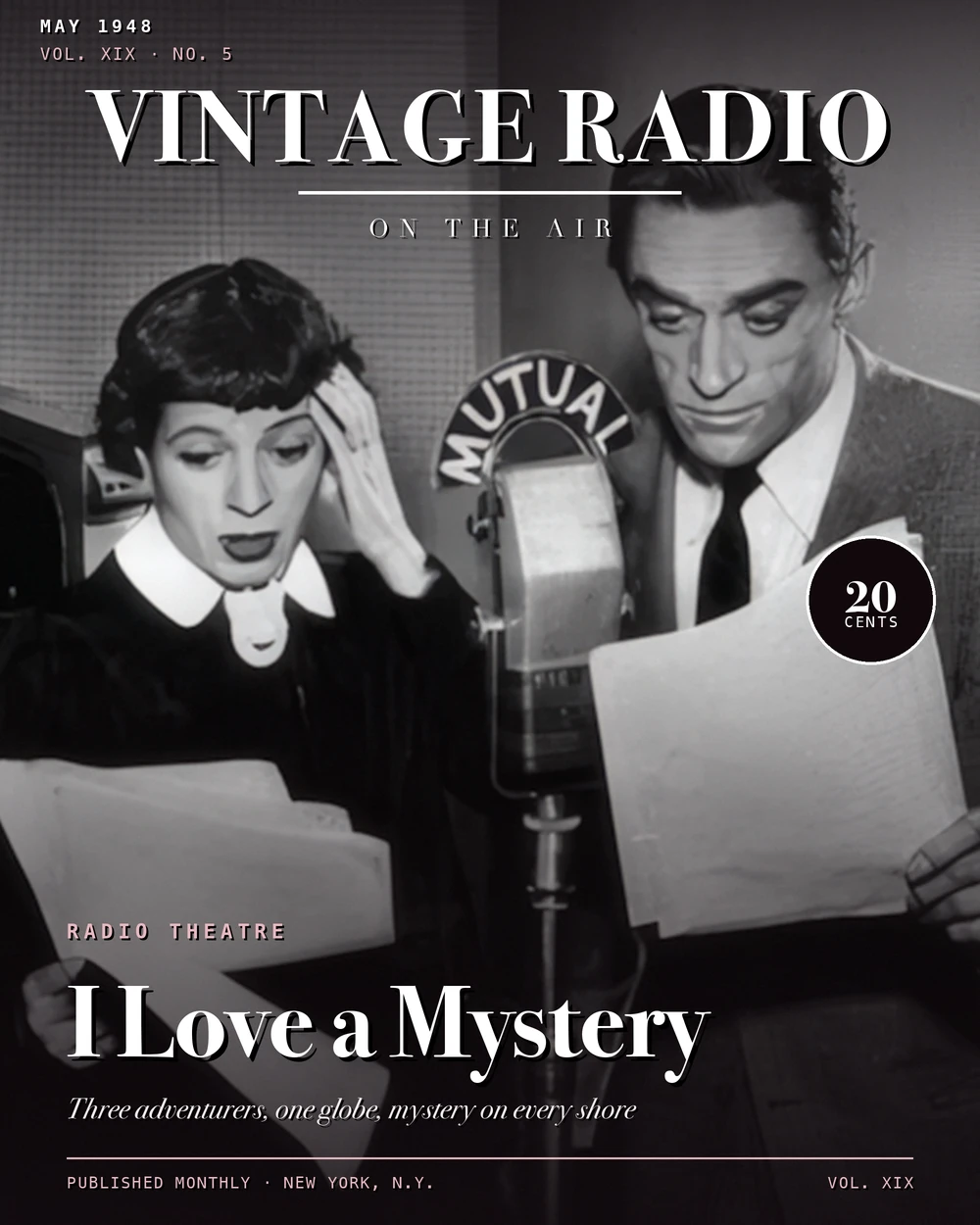
I Love a Mystery
Three Men and a Globe on the Desk
Carlton E. Morse kept a globe close at hand while writing I Love a Mystery. He said he never knew in advance where his three main characters might be sent next. That approach — exploratory, instinctive, never quite sure who the killer was until he got there — produced one of the most distinctive serials radio ever aired. The show premiered on January 16, 1939, on the NBC West Coast network, and the last episode went out on December 26, 1952, on Mutual. In between, it moved across four networks, changed formats twice, swapped out nearly its entire cast, and acquired a reputation as the most-sought and most-rumored program among radio listeners who cared about such things.
Morse was not a newcomer when he built I Love a Mystery. He had broken into radio in the 1920s and spent time at KGO in San Francisco producing mystery dramas and serials, including a series called Split Second Tales — a forerunner of the adventure stories he would later syndicate. Two of his key performers had worked with him before: Michael Raffetto, who had played Captain Carter Post on Split Second Tales, stepped into the role of Jack Packard; Barton Yarborough, who had played a character named Sergeant Long in an earlier Morse serial, became Doc Long. These were not random hires. Morse was building something out of pieces he had been shaping for years.
What makes the origin story richer still is that Morse was running two serials simultaneously for much of the early 1940s. He also wrote One Man's Family, a completely different kind of show — quieter, domestic, episodic in a different register entirely. In 1943, with both programs on different networks, he wrote One Man's Family on Mondays and Tuesdays and spent the rest of the week on I Love a Mystery. He said the two shows played off each other, that writing one made the other go better, stimulating rather than draining his imagination. That's an unusual creative claim, but the output supports it.
The A-1 Detective Agency and Who Ran It
The show's premise was simple on its face: three adventurers who had met during China's war with Japan, while all three enlisted in the Chinese cause, came back to California and set up shop as the A-1 Detective Agency. The office was one flight up, just off Hollywood Boulevard. But the trio were not ordinary private eyes. They were soldiers of fortune who sought action, thrills, and mystery wherever they could find them, and Morse gave each one a distinct enough character that listeners had someone to attach to.
Jack Packard, played by Raffetto during the Hollywood years, was the head of the outfit — a former medical student, logical, cool, and notably unaffected by women. Both Jim Harmon and Raymond William Stedman, two writers who documented the show's legacy, noted that it was explicitly stated at some point that Jack had once gotten a girl in trouble, a detail that added a specific kind of history to his apparent indifference. Doc Long, played by Barton Yarborough, was described as a redheaded alley fighter from Texas who loved women and spoke in a deep Panhandle drawl. His catchphrase — "Honest to my grandma...." — became the show's most-quoted line. Reggie Yorke, played by Walter Paterson, was the physically strongest of the three, distinctly English in voice and manner, with a surface propriety offset by a real talent for roughhouse.
Yarborough himself had come into the part with a varied background — born in Goldthwaite, Texas, in 1900, he had worked in vaudeville and with the Eve Le Gallienne Company before radio took him. The Panhandle drawl he adopted for Doc Long became so much a part of him that he carried it straight into his later role as Sgt. Ben Romero on Dragnet. He died of a heart attack in Burbank in December 1951, at fifty-one, while Dragnet was still in production. The episode that aired eight days later, The Big Sorrow, showed Joe Friday dealing with Romero's sudden death — radio and television absorbing the loss of a performer in real time.
The trio dynamic had changed earlier, in 1942, when Walter Paterson died by suicide. Morse had been a close friend, and could not bring himself to simply replace him with another actor. The character of Reggie Yorke was written out, and the agency acquired a new presence: Jerry Booker, described as the beautiful and curvaceous secretary at the A-1, played by Gloria Biondell. For a stretch the show was billed as the adventures of Jack, Doc, and Jerry. The energy shifted — the tight three-man unit of the early years became something slightly different, and the Hollywood run ended in 1944 with that different shape.
When the show resurfaced on Mutual in 1949, produced from the original scripts and recorded in New York, the cast was entirely new. Russell Thorson played Jack Packard, with Robert Dryden stepping in late in the run. Jim Boles took over as Doc Long. And Tony Randall, then building his career in New York, played Reggie Yorke — the character restored to the show even though Paterson was gone. One familiar name bridged the two productions: Mercedes McCambridge, who had played many character roles in Hollywood — often a fiery hellcat, sometimes a victim, occasionally a femme fatale — was by then pursuing a stage career in New York and appeared in the Mutual run in many of the same roles she had played years before in California.
What Morse Put on the Air
Morse wrote without knowing the ending. He gave every suspect motive and opportunity, sometimes a puzzling alibi, and trusted the story to show him who had done it. That method sounds loose, but the results were tightly plotted enough that listeners stayed with story arcs that, in the 15-minute episode format, were wrapped up within about three weeks. The weekly half-hour stories that ran during the NBC Thursday-night stretch in 1940 went eight to thirteen weeks.
The content was graphic by any standard of the era. As many as three characters were murdered in a single 15-minute episode. The methods included throat-ripping by wolves, garrotings, poisonings, and mysterious slashings. In Monster in the Mansion, a headless black cat turned up in a lady's bed, and a man had his arm amputated while he slept. In The Thing That Cries in the Night, a slasher moved through an old mansion while murders were committed to the sound of a baby crying — a baby no one admitted had been in the house for twenty years. The story Temple of Vampires was considered so vivid that the Nicaraguan government lodged a formal protest during the show's Hollywood run.
Morse kept a collection of reference books on pagan symbols and heathen gods to feed the darker material. That library shows in the episode titles alone: The Fear That Creeps Like a Cat, The Snake with the Diamond Eyes, Monster in the Mansion, The Pirate Loot of the Island of Skulls. These were not decorative titles. The stories tried to earn them. The Mutual network's eventual scheduling of the show at 10:15 PM in the early 1950s was itself a signal about the content — this was not standard juvenile fare, though children apparently listened anyway, under blankets with the volume low.
Morse's habit of building characters on real-world models occasionally drew unwelcome attention. Peter Lorre once sent him a letter threatening legal action because a recurring character named Michel — appearing in two of his serials — sounded too much like Lorre. Morse dropped the character shortly after.
The Sound of the Thing
Morse wrote sound direction into his scripts in considerable detail, and nothing demonstrates this better than Stairway to the Sun, an adventure that aired in June and July of 1943 and became the story most remembered and most discussed by people who cared about the show.
In Stairway to the Sun, Jack and Doc lead an expedition 700 miles up the Orinoco River into Venezuela. They are attacked by prehistoric flying reptiles and forced down into the jungle, eventually reaching a plateau 9,000 feet high covering 400 square miles. Morse's script directed the soundman to build the approach to the plateau using a waterfall record supplemented by a thunder-sheet and rushing-river records to create what the script called a tremendous sound. The call list included piercing and crashing sounds, a wildcat whistle, a tree crashing, a ricocheting rifle shot, cannon fire, and rolling thunder. As the characters enter the mind-warping environment near the waterfall, Morse called for a celeste played in a hall with an echo chamber.
The effect at the waterfall itself was this: as each person passes under it, they hear a chorus of voices calling their name — in their own voice. When the roar stops, a mockingbird sings. After that, the characters enter a canyon a mile deep with stairs cut into the cliff face, leading up through the clouds. Doc, in his Panhandle drawl, calls it "a dad-blamed stairway to the sun."
The show's overall sonic signature was built from the same care. Its theme was Valse Triste by Sibelius, unusual and distinctive. The opening included the wail of a train and the sting of an organ. A clock chime brought listeners back after the recap at the start of each episode. Sound effects were handled by Ralph Amati at NBC, Al Span at CBS, and George Cooney and Barney Beck at Mutual — each production stage had a dedicated craftsman responsible for it.
The Network Years
The show moved around more than most serials. The NBC West Coast run, sponsored by Standard Brands for Fleischmann's Yeast, aired at 3:15 in the afternoon in 15-minute weekday episodes, starting in January 1939. By October of that year it had expanded to the full NBC network at 7:15 PM on weeknights. A third NBC phase in the spring of 1940 shifted to a weekly half-hour on Thursday evenings at 8:30.
From September 1940 through June 1942, the show ran on the Blue Network on Mondays and Wednesdays at 8 PM. Fleischmann's Yeast had been the sponsor throughout, but wartime shortages ended that arrangement. After a gap, the show returned in March 1943 on CBS, now in the 15-minute weeknight format at 7 PM and sponsored by Procter & Gamble for Oxydol and Ivory Soap. The CBS run continued through December 1944, with John McIntire and Jay Novello each briefly filling the Jack Packard role that Raffetto had stepped away from.
There was then a hiatus of several years before Mutual picked up the show in October 1949. The Mutual run, transcribed in New York from the original Hollywood scripts, continued until December 26, 1952. The schedule shifted during that run from 7:45 PM in the first year to 10:15 PM from 1950 onward, which placed it firmly in adult territory for the last two years of its life.
In between, the trio had one further outing under a different name. From April through July of 1948, ABC carried I Love Adventure — a 30-minute weekly series running 13 episodes, with Raffetto back as Jack Packard and Yarborough back as Doc Long. The premise had been reworked: the A-1 Detective Agency was set aside, and Jack, Doc, and Reggie now operated as partners in the Twenty-One Old Men of 10 Gramercy Park in London, described as a powerful extra-governmental organization. The new Reggie was Tom Collins — born Beryl William Collins in Chicago in 1913, and already known to listeners as Chandu the Magician.
What Survived and What It Meant
The show's legacy among listeners and collectors was shaped as much by scarcity as by quality. For years, the belief circulated that recordings of both the Hollywood and New York runs were held by a California collector who refused to release them. Whatever the truth of that, I Love a Mystery was described as the most-sought of all radio shows and the one most fraught with rumors.
Most of what survives comes from the New York run. Three complete stories are known from that period: The Thing That Cries in the Night, Bury Your Dead, Arizona, and The Richards Curse (missing one chapter). Partial recordings of Temple of Vampires and a few other New York stories also exist. From the Hollywood run, the most substantial surviving material comes from The Pirate Loot of the Island of Skulls — two half-hour chapters and surrounding fragments, including a sequence in which Doc Long climbs to the roof of the Temple of Jaguars and fights the high priest Holy Joe to the death.
The scripts themselves fared better than the recordings. The Library of Congress holds the Carlton Morse Copyright Script Collection in its Recorded Sound Reference Center, which includes 47 I Love a Mystery scripts along with 4 from Adventures by Morse and 13 from I Love Adventure. Additional Morse papers are housed at Stanford University Libraries (M0362) and at the City of Thousand Oaks Library. On the audio side, pioneering collector Joe Hehn (1931–2020) built the most substantial private holding; his materials now sit in the Joe Hehn Memorial Collection, preserved with support from a group of transcription-disc preservationists who called themselves the Knights of the Turning Table. The scarcity also spurred recreations: in 1989, episodes 8–15 of The Temple of Vampires were rebuilt for Bud Carey's Old Radio Theater on KALW; in 1996, Jim Harmon Productions recreated The Fear That Creeps Like a Cat with Les Tremayne as Jack, Tony Clay as Doc, Frank Bresee as Reggie, and Fred Foy as announcer; and in 2009, Audio Cinema Entertainment received the blessing of the Morse Estate to produce recreations of the full series based on the Hollywood run.
Listeners who had followed the original Hollywood cast generally regarded the New York version as a lesser thing. The quote sometimes attached to that view came not from a radio critic but from William Faulkner, who reportedly said, "Given a choice between Scotch and nothing, I'll take Scotch" — meaning the New York shows were better than silence, even if they weren't the original. Whether that captures the full picture is debatable. Tony Randall's Reggie Yorke, and the performances of Dryden and McCambridge in New York, gave the later run its own character.
Columbia Pictures had tried to extend the franchise into film. The studio acquired the rights intending to make two pictures a year for five years; only three were ever produced. The first, in 1945, was directed by Henry Levin, with a screenplay by Charles O'Neal adapted from the now-lost radio serial The Decapitation of Jefferson Monk and renamed The Head of Jonathan Monk for the screen. The studio cast Jim Bannon over Michael Raffetto on the grounds that Bannon was more "movie-genic," a decision that — according to Bannon's autobiography The Son That Rose in the West — left Raffetto furious. Bannon recalled Morse being on set for the 1945 shoot and raising no objection to the adaptation, though Bannon himself admitted the picture "limped a little." A fourth, related effort came earlier: The Missing Juror (1944), again starring Bannon, was Columbia's adaptation of The Fear That Creeps Like a Cat, with the lead renamed Joe Keats and the ILAM branding stripped off.
The show's reach into later popular culture has been more affectionate. William Goldman gave a character in Marathon Man (1974) the nickname Doc, and explained in chapter nineteen that it was a tribute to Doc Long. Brett Halliday had used the show even earlier, in a 1945 short story called Murder with Music, in which I Love a Mystery plays on the radio as part of a character's alibi for murder. Jim Harmon, who first publicized the show's pleasures more than two decades before it was written up in the major radio reference literature, called I Love a Mystery the greatest radio show of all time. That's a strong claim for a medium that produced a great deal of strong work, and reasonable people can argue about it. But the argument itself — the decades of discussion, the scarcity, the rumors, the specific devotion of listeners who grew up hearing those three men head off to wherever Morse's globe pointed next — says something real about what the show managed to do.